


Answers to all your questions

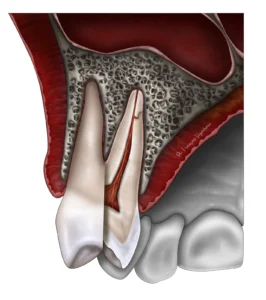 A tooth consists of two parts: the crown, which is visible in the mouth, and the root, which is located in the jawbone and anchors the tooth in place.
The hard tissues that make up the body are:
- enamel, a very hard tissue that surrounds the crown of the tooth
- dentin, a hard tissue that supports the enamel and makes up the root
- dental cementum, a hard tissue that surrounds the root of the tooth
At the center of the tooth is the dental pulp, a soft tissue that contains, among other things, nerve fibers and blood vessels, and extends from the crown to the tips of the roots (apex).
A tooth may have one or more roots, and a root may have one or more canals containing the pulp.

Endodontics is the branch of dentistry that specializes in the physiology and pathology of the human dental pulp and the tissues surrounding the tooth roots (periradicular tissues).
Practicing this field requires knowledge of fundamental sciences such as pulp biology, etiology, diagnosis, prevention, and treatment of pulp diseases and disorders, as well as associated periradicular lesions.

An endodontist is a dentist who has completed additional training in endodontics beyond their initial dental education and whose practice is limited to endodontic treatments. Their practice focuses on diseases related to the dental pulp, the organ that includes, among other things, the nerves of the tooth. The goal of endodontists is to treat tooth roots painlessly and to contribute to patients’ oral health by preserving healthy teeth in the mouth.
The endodontist uses advanced techniques to treat the pulp and related conditions. Treatments are performed under an operating microscope, with the assistance of a dental assistant specially trained in endodontics, using aseptic techniques and specialized materials.

Endodontists treat the roots of teeth that may present with conditions such as: deep decay close to or reaching the pulp; a tooth with severely inflamed (pulpitis) or necrotic (dead) pulp; a tooth that has suffered trauma; a dental abscess; or a fractured tooth… In some cases, an endodontist may need to assess whether a tooth can be saved and make a complex diagnosis.
A painful tooth does not necessarily indicate a condition that requires endodontic treatment. Therefore, your dentist is best suited to determine whether your tooth requires the expertise of an endodontist and will refer you if necessary.

All of the procedures we perform are done under local anesthesia and are therefore pain-free.
We provide targeted care at specific points in the treatment process and make a special effort to listen to and support our patients so that their endodontic care is personalized, stress-free, and pain-free.
It’s perfectly normal to feel a little anxious before endodontic treatment or endodontic surgery. Please don’t hesitate to ask us any questions you may have so that we can explain the exact procedure for each treatment.

The practitioners on our team are in-network, which means that 60% of the cost of care is covered based on the Social Security reimbursement rate.
The other portion—which covers the facilities and time required to provide quality care—is not reimbursed by Social Security. These additional fees may be covered later by your supplemental health insurance.

Payment for treatment is due at the end of the treatment. You may pay by credit card, check, or cash. For large amounts, you may spread out payments over several installments by paying by check. Checks will then be cashed according to the schedule agreed upon between the patient and the practitioner.


If you are a minor, you must be accompanied to the office. However, the practitioner may ask your parents to wait in the waiting room to ensure you receive the best possible care.

It is normal to experience some sensitivity in the treated area for a few days after root canal treatment, as the body undergoes a natural healing process. You may also experience some discomfort in your jaw due to having your mouth open for an extended period during the procedure. These symptoms are temporary and generally respond very well to over-the-counter pain relievers. Be sure, however, to follow the recommended dosage and be aware of any possible contraindications.
The tooth may feel slightly different from the others for a while, but it shouldn’t be painful. If swelling occurs, or if the pain is too severe or lasts longer than a week, please don’t hesitate to contact the office.
The success rate reported in the scientific literature ranges from 80% for endodontic retreatment of an infected tooth to more than 90% for initial treatment of a non-infected tooth.
You can find postoperative care instructions for endodontic treatment and endodontic retreatment.

The aftereffects of endodontic surgery are relatively painless and can be managed with a standard pain reliever that we will prescribe before the procedure.
After surgery, it is normal to experience swelling, which often appears on the 3rd day and may last until the 5th day. The recovery is generally not very painful. You may return to work, but it is important to avoid physical activity for one week following the surgery.
The success rate of endodontic surgery is over 90%.
You can find postoperative care instructions for endodontic microsurgery.

Whether you can return to work depends on the complexity of the surgery and your overall health. After a minor procedure, you can return to work. For more complex surgeries, it is advisable to consult your dentist.
Yes, in most cases, you can drive after root canal treatment or surgery. These procedures are performed under local anesthesia, which should not affect your ability to drive.
However, it is important to take certain factors into account:
- Effects of Anesthesia: While the anesthesia is still taking effect, you may feel numbness in your mouth and lips, but this should not affect your alertness or your ability to drive.
- Pain or Discomfort: After the procedure, you may experience mild sensitivity or pain in the treated tooth. If you take pain relievers, make sure they do not affect your ability to drive safely.
- Duration of treatment: If your treatment took a long time, you may be tired. In that case, it’s a good idea to rest before hitting the road.
It’s always a good idea to follow your dentist’s recommendations after treatment to ensure that you are able to drive safely.
As a general rule, endodontic treatment and/or surgery do not warrant a sick leave. However, in exceptional circumstances, your dentist may issue you a sick leave note.

In most cases, if your endodontic treatment or surgery went smoothly and you are not experiencing excessive pain, there are no major contraindications to flying. However, it is recommended that you take certain precautions to ensure your comfort and avoid complications.
If you are taking antibiotics or other medications to prevent infection or manage pain, be sure to follow your treatment plan carefully and bring them with you on your trip. Also, make sure you have enough medication to last the entire trip, and be sure to keep them in your carry-on luggage.
You should always consult your dentist for personalized advice based on your specific situation.

Our office is located at 4-6 rue Jean-Pierre Bloch in Paris’s 15th arrondissement, 50 meters from Avenue de Suffren.
The office is easily accessible by a 7-minute walk from the Dupleix (Line 6) or La Motte-Picquet Grenelle (Lines 6, 8, 10) metro stations; by bus, it’s a 3-minute walk from the Champs de Mars bus stop (Lines 69, 82, 86); or by the RER C, it’s a 9-minute walk from the Champ de Mars station – Tour Eiffel.
Parking spaces are often available on Rue de la Fédération or Rue Jean-Pierre Bloch.


To schedule a treatment appointment that is appropriate for your situation, our team needs a letter from your treating dentist, as well as X-rays of your tooth and, if necessary, other diagnostic tests (CBCT [Cone Beam CT], CT scan, etc.).
You can fill out all this information using the dedicated patient form available here.
A more comprehensive form for the healthcare provider who referred you is also available here.
Once we receive this information, our team will contact you to schedule an appropriate appointment.
You can also schedule an appointment by phone at 01.40.60.70.31, making sure to have all the information you have on hand.
Once your appointment is scheduled, you’ll receive a text message reminder a few days before the scheduled date.
Despite all these precautions, anyone can forget an appointment. That’s why our team will call you to reconfirm the appointment one last time.

If you would like to cancel or reschedule your appointment, simply let us know 48 hours in advance by phone at 01.40.60.70.31 or by email

An endodontist holds a degree in dentistry. Although it is recognized in many countries, endodontics is not yet recognized as a specialty in France. However, there are numerous postgraduate training programs that allow practitioners to acquire the skills necessary for the exclusive practice of endodontics: Certificates of Advanced Studies (CES), University Diplomas (DU), Inter-University Diplomas (DIU), or foreign postgraduate programs in which the specialty is recognized.